
McLeod County Projected Release Dates
A projected date is a planning date. For a Minnesota state prisoner, the official label is Anticipated Release Date. The date can move before physical exit. It is distinct from Expiration Date, which marks the end of DOC jurisdiction, and from Under Supervision as of, which is retrospective evidence that prison confinement ended by the status date.
McLeod County Jail uses a different record system. Its current roster can sometimes display a prospective release note for a sentenced person, but the county does not publish the calculation method. A court order also may precede jail processing. The actual sheriff release timestamp, legal basis, and any receiving authority are the reliable historical fields.
A pretrial detainee usually has no fixed sentence-based date. Release may turn on bond, recognizance, dismissal, a court order, or the resolution of another hold. A future note should never be recaptioned as completed release.
Find McLeod County Release Dates
The right lookup follows the custodian. The Minnesota DOC Viewer is for adults committed to the Commissioner. It is not a historical McLeod jail list. The county roster is current-only and does not become a state sentence calculator.
- Determine whether the person is in McLeod County Jail, a Minnesota DOC prison, or another system. Use the source's facility and status labels, not the place of arrest alone.
- For a state prisoner, open the Minnesota DOC Public Viewer. Search by exact six-digit MNDOC ID or by first and last name, including known name variants.
- Confirm the match with birth date, aliases, offense, court file number, and sentence date. Recently imposed sentence data can take several business days to appear.
- Record Anticipated Release Date, Current Status, Expiration Date, facility, and caseworker as separate fields. Do not substitute one for another.
- For a local jail sentence, read the judgment and jail-credit entries in the McLeod court case, then ask the jail to confirm its calculation and any holds.
- After the expected date, verify the actual change through the new status, the jail, or the responsible records office.
The official DOC example displays the exact Anticipated Release Date field beside other sentence information.
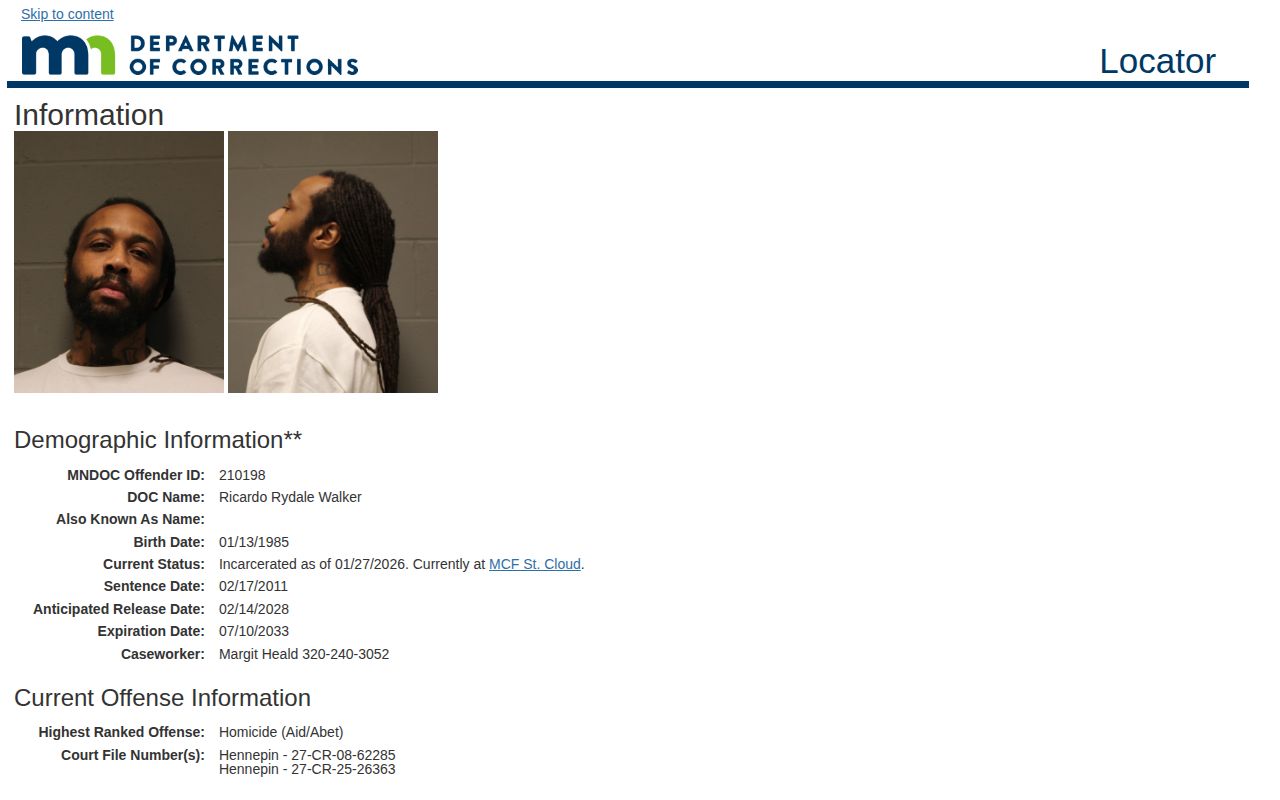
The image shows why each date label must be copied precisely rather than reduced to a generic “release date.”
For a named person's full county release trail, the McLeod County release search adds VINE, court, and written sheriff data to the present-custody check.
McLeod County Two-Part Sentences
Minnesota is not an 85-percent state. The common “serve 85 percent” shorthand does not state Minnesota's ordinary rule. For fixed executed felony sentences covering offenses on or after August 1, 1993, Minnesota Statutes section 244.101 divides the sentence into two parts. The minimum imprisonment term is two-thirds, and the maximum supervised-release term is one-third, subject to section 244.05.
Start with the executed sentence imposed by the court and apply lawful jail credit. The baseline post-1993 calculation places two-thirds in imprisonment and one-third in supervised release. Disciplinary confinement can add to the prison term. Under section 244.05, subdivision 1b, that time reduces the supervised portion rather than expanding the total sentence.
Ordinary determinate sentences do not rely on a routine parole-board decision. Minnesota's Supervised Release Board handles narrower classes such as certain life, old indeterminate, certified juvenile, and specified criminal-sexual-conduct sentences. A Board eligibility or review date is not an actual community release date.
Jail credit is another input that must come from the judgment and the agency applying the sentence. It accounts for qualifying time already held, but a reader should not recompute the credit from arrest dates alone. Concurrent and consecutive terms, later amendments, and separate files can change the result. Ask the court for the controlling judgment and DOC for the calculation it used.
- Executed sentence
- The term the court orders to be served.
- Imprisonment term
- The confinement part of an ordinary fixed state sentence.
- Supervised-release term
- The community part that remains under DOC jurisdiction.
- Expiration date
- The scheduled end of DOC jurisdiction, not the prison-exit date.
Note: The two-thirds rule governs the ordinary state sentence described by statute, not every term served in McLeod County Jail.
McLeod County Old Good Time
Old “good time” is not Minnesota's current general rule. Section 244.04 applies to a narrow historical group: presumptive fixed sentences after May 1, 1980 for crimes committed before August 1, 1993. It provides one day of reduction for every two discipline-free days.
The old statute excludes mandatory life sentences and crimes committed on or after August 1, 1993. Applying that formula to a newer sentence would produce the wrong date. The offense date matters, not simply the year in which the person happens to be confined or searched.
For a disputed McLeod-linked state sentence, compare the judgment, offense date, DOC record, and the statute that governs the sentence class. DOC Central Records can explain whether a displayed date reflects the ordinary two-part framework, old good time, an incentive credit, or another rule.
McLeod County Earned Release Credit
The Minnesota Rehabilitation and Reinvestment Act adds earned incentive release credit, often called EIRC. It does not turn Minnesota into an 85-percent state and does not restore old good time for all prisoners. Sections 244.43 through 244.45 tie credit to work on an individualized rehabilitation plan and DOC policy.
The statutory maximum is 17 percent of the total executed sentence. Credit cannot reduce prison time below one-half of the executed sentence, and it does not lengthen the supervised-release term. Credit may be revoked for facility-rule violations or criminal acts committed while incarcerated. Life sentences, pre-May-1980 indeterminate cases, and old-good-time cases are excluded under section 244.45.
DOC Policy 204.064 calls each unit a day of credit toward an Earned Incentive Release Date. Implementation is a rolling pilot with phased work continuing through 2026 to 2028. Eligibility and operational limits can change with the live program. Open warrants, detainers, cases, or other custodial obligations can affect participation or release planning. Check DOC's current MRRA implementation page rather than freezing an old summary.
Note: An EIRC-adjusted date remains anticipated until DOC records the person's actual status change.
What Changes McLeod Release Dates
A displayed date is the result of law, sentence data, credit, and release planning. The source of a change determines which office can explain it. Court amendments belong with the court; sentence calculations and prison discipline belong with DOC; local holds may require the holding agency.
| Factor | Possible effect | Best confirmation |
|---|---|---|
| Disciplinary confinement | Adds confinement under the governing sentence rule and can reduce supervised-release time | DOC sentence explanation |
| EIRC award or revocation | Moves an earned incentive release date for an eligible case | Current DOC record and policy |
| Court amendment or corrected credit | Changes the legal sentence inputs | McLeod court judgment and DOC update |
| Warrant, detainer, or hold | Can block community exit or produce transfer to another authority | Holding and receiving agencies |
| Release-plan issue | Can delay an otherwise expected state release | DOC facility, caseworker, or agent |
| Weekend or holiday statute | Moves processing to an earlier or later eligible day based on offense date | Section 244.05 and DOC |
A transfer date is not a community release date. If McLeod County Jail sends a person to DOC, another jail, federal custody, or immigration custody, the sheriff's transfer fields identify the next authority. The later exit must be confirmed in that receiving system.
The same care applies to release planning. An anticipated date can remain visible while an agent-approved plan, placement, or custodial obligation is unresolved. The caseworker or facility can explain the operational status, and Central Records can explain the sentence field. A court clerk can supply the judgment but does not control the prison's physical exit process.
McLeod County Weekend Release Rule
Minnesota's weekend and holiday rule reverses direction based on the offense date. Under section 244.05, subdivision 1a, a scheduled Friday, Saturday, Sunday, or holiday date for an offense before August 1, 1992 moves to the last earlier eligible day. For an offense on or after that date, it moves to the first later eligible day.
This is not a simple “release early for the weekend” rule. Two records with the same displayed day can move in opposite directions because their offense dates fall on different sides of the statutory line. The adjusted processing day also does not erase a warrant, detainer, or other legal bar.
When a weekend date matters, save the offense date, the scheduled date, the observed DOC status, and the agency confirmation. These four facts explain why an anticipated calendar date may differ from the day the person actually leaves prison.
McLeod County Jail Release Dates
County jail calculations are not DOC Locator calculations. McLeod's live In Custody List may carry a prospective “Release Date” note, but the sheriff does not publish a public formula for that field. Use the sentencing judgment, lawful jail credit, the sheriff's own calculation, and any controlling local or state rule.
A pretrial person may leave after bond or court order without a sentence-based projected date. A sentenced jail inmate generally follows a different process. McLeod says sentenced releases usually occur at 7:30 a.m. into the jail lobby. Court release paperwork may reach the jail at about 1:30 p.m. at the earliest, after which processing can take one to four hours. Those operational facts explain why the court's action time and physical exit time differ.
Call McLeod County Jail at 320-864-5191 for current public status. For historical proof, request the actual release date and time, legal basis, and recipient agency if transferred. A court order answers why release was authorized. The sheriff record answers when county custody ended.
Confirm McLeod County Actual Release
After the anticipated day, inspect the correct status again. For a state prisoner, “Under Supervision as of” is stronger retrospective evidence than the earlier anticipated date. Then read the “Currently with” field because supervision alone does not guarantee physical presence in the community. A fully discharged person may disappear from the live Viewer.
For county jail custody, Minnesota VINE may report a release or transfer event, but it is not a state-prison notification service. Exact county release time and legal basis still come from the jail record. Minnesota Haven handles state-prison notifications through DOC Victim Assistance.
The VINE Inmate Check explains county-jail event alerts and their limits. If a DOC date is unclear, contact Central Records at co-records.doc@state.mn.us and ask it to label the prison-exit, supervision-start, and expiration dates separately.