
Federal BOP Release Destinations
No BOP institution was identified in McLeod County. The federal prison system still matters when a person connected to the county is convicted in federal court or transferred after local custody. A BOP release can mean the federal imprisonment term ended and the person entered the community, moved into a form of supervised release, or left BOP custody for another authority. The locator describes BOP status, not all legal control.
A county transfer record may name a federal recipient, but it confirms only that McLeod custody ended. U.S. Marshals Service custody often comes before BOP designation. ICE, a state agency, or a local jail can also receive someone after BOP. Check the federal docket and any named receiving authority before calling the event a community release.
Confirm a Federal BOP Release
The BOP Inmate Locator covers federal records from 1982 forward, while earlier coverage is incomplete. Search by BOP, DCDC, FBI, or INS number for the strongest match. A name search also accepts optional age, race, and sex. Compare the federal register number and identity details rather than relying on a common name.
- Search by the exact federal number when known, or use full name plus available identity filters.
- Open the matching result and record the custody label, location, Release Date, register number, and observation date.
- Read a past date with “Released” or “Not in BOP Custody” as exit from BOP only.
- Treat a future date as projected and subject to change, including sentence-credit recalculation.
- Check the federal court docket and other likely custodians when the result says released, in transit, unknown, or returns no match.
The McLeod County released inmate search is the better route when the person had only a county booking. Minnesota DOC records apply to state-prison commitments, not federal sentences.
Federal BOP Release Records
The locator is the first public records route for a sentenced BOP prisoner. The official BOP field definitions explain that “Released” or “Not in BOP Custody,” with no facility, means the person is no longer held by BOP. The federal sentencing docket adds the judgment, release orders, sentence changes, and supervision terms. Agency records beyond the public locator require the applicable BOP records process.
No BOP institution verified in McLeod County
Public route: BOP Inmate Locator
Record scope: federal BOP custody
Court route: federal Clerk or PACER docket
Do not send a BOP question to the McLeod sheriff’s records form unless the question is about the county transfer itself. The sheriff can identify when McLeod custody moved and which agency received the person. BOP controls the later federal prison record.
Federal BOP Locator Fields
The public result is short, but its labels have distinct meanings. Read them with the federal case rather than converting every date into the same event.
| Locator result | What it establishes |
|---|---|
| Released / Not in BOP Custody | BOP no longer holds the person; another custodian or supervision may remain. |
| Past Release Date | The recorded actual exit date from BOP custody. |
| Future Release Date | A projected date that may change. |
| In Transit | Movement or temporary USMS custody, not release. |
| Unknown | The confinement term has not been determined. |
| No result | No match under the search, not proof of community release. |
A federal defendant released before trial, acquitted, or never designated to BOP may have no BOP entry. The court docket and U.S. Marshals Service records are then more relevant.
Federal BOP Release Screen
The official BOP locator provides both number and name search routes.
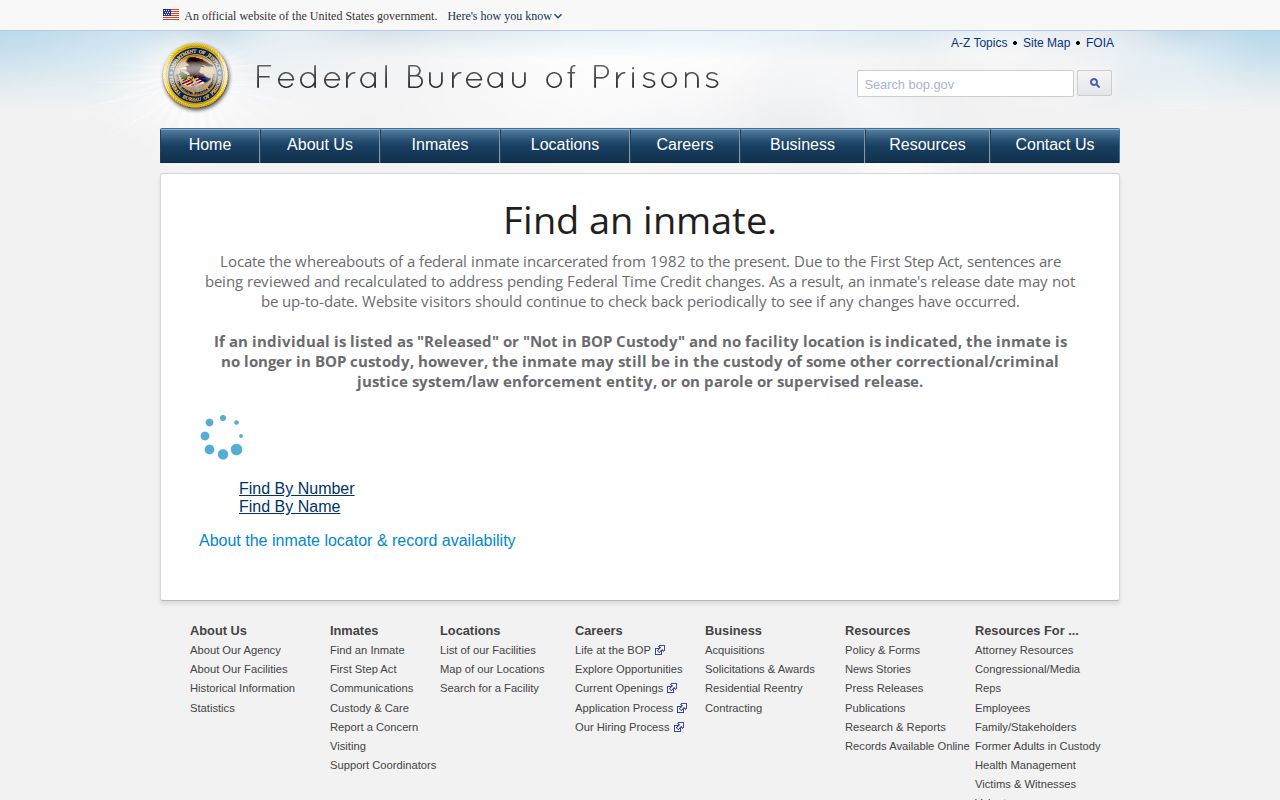
The locator screenshot shows the correct federal system entry point. The result still needs identity matching and a second check for another custodian after the BOP date.
Federal Custody Stages and Release
Federal custody can pass through several agencies. A court may remand a defendant, meaning order the person held, to the U.S. Marshals Service before trial or sentencing. After conviction and designation, the person may enter BOP custody. A later BOP exit may lead to supervised release, which is court-ordered monitoring after prison, or to another custodian.
- USMS custody
- Federal pretrial, court, and transport custody before delivery to BOP or release by the court.
- BOP custody
- Federal imprisonment under the Bureau of Prisons.
- Supervised release
- A federal court’s post-prison supervision term, separate from physical BOP custody.
- Detainer
- A legal request that another authority receive or continue to hold the person.
The stages explain why one search cannot answer every federal question. A BOP result should be paired with the federal case when the actual legal outcome matters.
Missing Federal BOP Release Records
A blank search may reflect an identity mismatch, a pre-1982 record, a person held only by USMS, a defendant who never entered BOP, or an incomplete historical record. Try the exact register number and name variants before changing systems. If the person was in federal pretrial custody, use the Clerk or PACER docket to locate an order of release, acquittal, remand, sentence, or commitment.
If BOP shows a release but ICE custody is possible, search the ICE detainee locator and read its limits. If a Minnesota or McLeod hold is involved, check those current custody systems. A date from one authority proves only that authority’s custody event. The most reliable chain records who held the person before the event, what the event was called, and which authority came next.
Reconcile Federal BOP Release Dates
A federal case can display a sentence date, projected release date, actual BOP Release Date, court supervision start, and supervision end. They should not be combined. A past BOP Release Date is the actual federal prison-custody exit recorded by BOP. A future date remains projected. The judgment describes the sentence, while the federal probation record concerns supervision after prison.
Record the date when the locator was checked. If a value changes, the observation time explains which public version was seen. First Step Act credit recalculation can affect a future date. A court order or sentence amendment can also change the legal term. Ask BOP or use the federal docket when the reason for a change matters.
Identity must be reconciled first. Match the federal register number, complete name, age or birth details when available, and federal case number. A county booking number or MNDOC ID belongs to a different system. Keeping each identifier with its agency prevents two people or two custody stages from being joined by mistake.
Build a Federal BOP Release Record
Begin with the BOP result and save the status, Release Date, register number, and observation date. Next, read the federal docket for the judgment, sentence changes, and post-prison supervision. If the person entered federal custody from McLeod County Jail, use the sheriff’s written records route to document when local custody ended and which federal authority received the person.
If the BOP result says In Transit, keep searching rather than announcing release. Temporary Marshals custody can be part of transport. If the result says Released, check the docket for supervised release and look for another custodian only when the case facts support it. ICE ODLS, a state DOC search, and a local roster each cover their own systems.
No BOP institution was verified in McLeod County. Do not assign a local prison address or phone number to this serving system. Contact information should come from the actual BOP institution shown in the person’s result or from the federal case and official BOP channels.
Older Federal BOP Release Records
The locator’s general coverage begins in 1982, and earlier records are incomplete. A missing older result therefore has a known coverage limit. Search the federal court file, historical federal records, and the responsible agency rather than treating the blank screen as a conclusion.
Even within the covered period, the locator does not include every person who faced a federal case. Someone released before trial, acquitted, or held only for transport may never have become a BOP prisoner. The court case is the durable starting point for those paths. USMS FOIA is the agency route when a Marshals custody or transport event must be documented.